
Ai2 has released HiRO-ACEv2, an AI system for generating detailed simulations of rain, near-surface wind and sea-level pressure. Its October 13 research preprint reports an inference-compute requirement below one three-hundredth of that of traditional numerical global storm-resolving models. That is a measure of running the trained system; it does not establish the total cost of a climate research program.
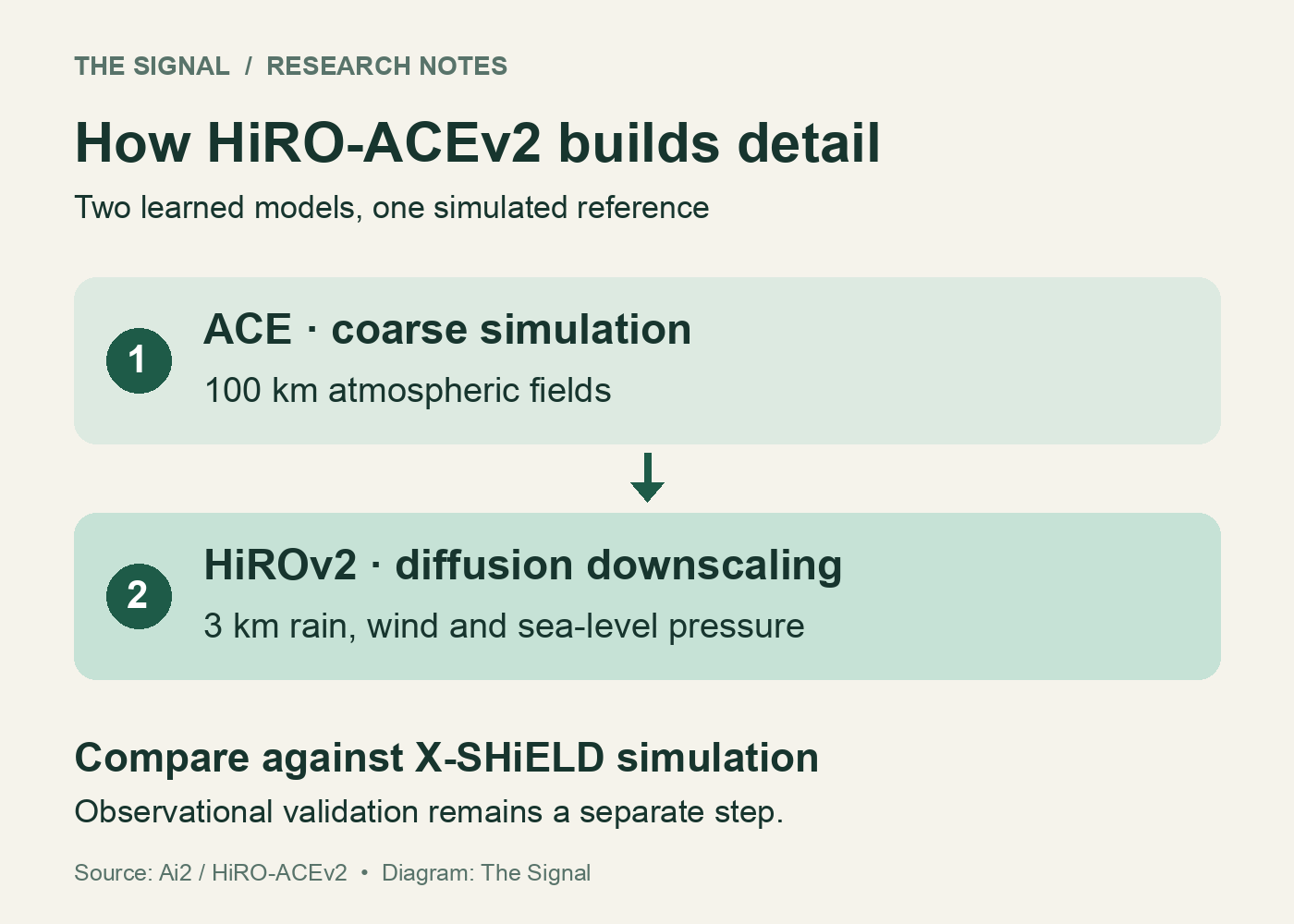
The mechanism is a division of labor. ACE generates atmospheric conditions on a coarse, 100-kilometer grid. A separate diffusion model, HiROv2, reconstructs detail at 3 kilometers. The authors compare the resulting weather statistics with X-SHiELD, the numerical simulation used as the reference. Their paper reports close agreement even at the extreme tails of rainfall and near-surface wind distributions.
For researchers, cheaper repeated runs could make it practical to examine more possible extreme events within a fixed computing budget, provided the generated events preserve the particular properties that their study needs to measure when compared with the X-SHiELD reference.
X-SHiELD fidelity first.
The released model card puts firm boundaries around that prospect. The coarse emulator was trained on nine years of X-SHiELD output, covering 2014–2022, and may fail to produce independent, representative samples when run much longer. Ai2 says it is unsuitable for weather forecasting. The fine-resolution model reproduces X-SHiELD's features, with validation against observations still a separate requirement.
The geographic limits also deserve attention: HiROv2 has not been trained or tested outside 66° south to 70° north. Available checkpoints and inference instructions let researchers inspect and run the system; the model card lists Apache 2.0 licensing. Access to weights makes evaluation possible, while suitability still depends on the task.
Ai2's October 14 announcement says warmer-future climates and historical reanalysis data such as ERA5 remain outside the current system's supported scope. Training on a simulated world 4°C warmer is planned. For a first evaluation, pick a region and an extreme-event statistic, reproduce the X-SHiELD comparison, and record where the agreement breaks before using the output in a risk decision.