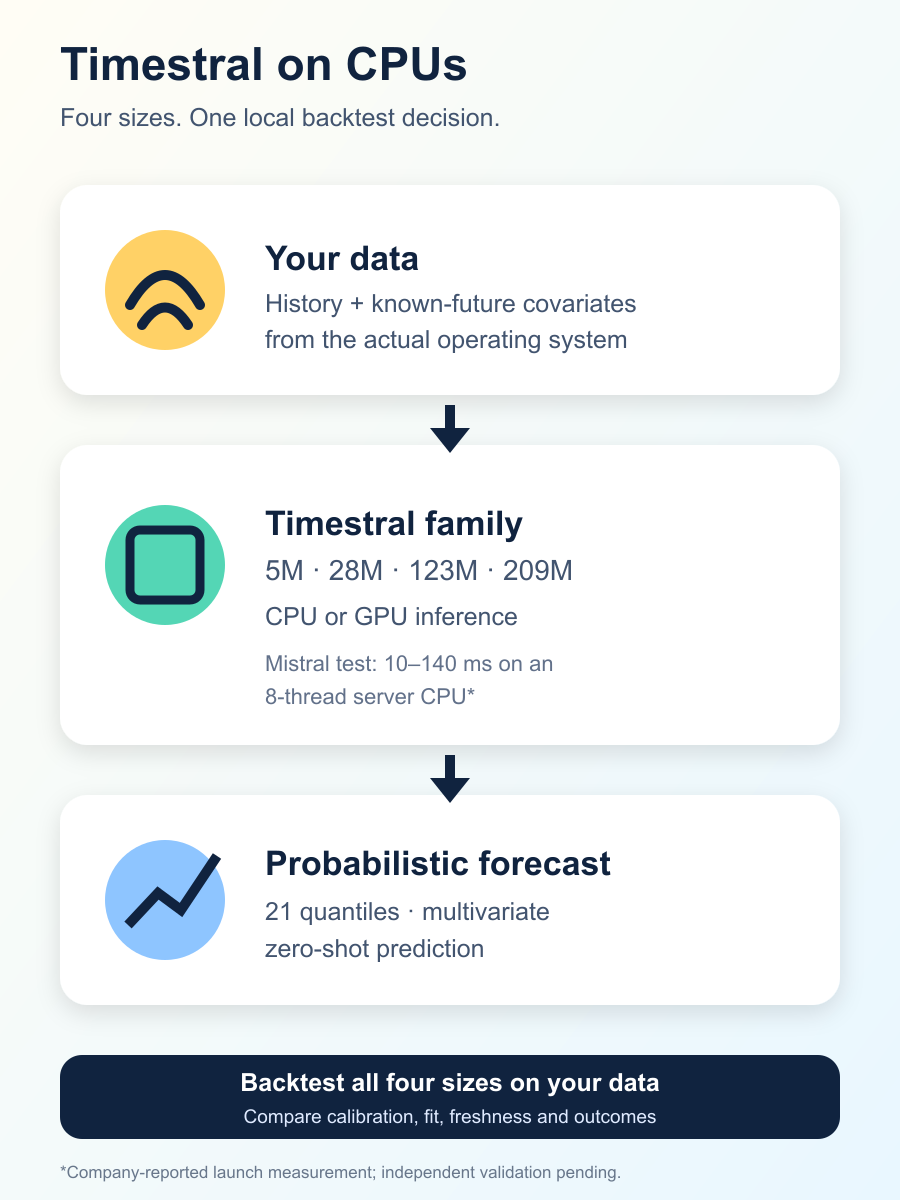
Mistral AI released Timestral on October 15, 2026, with four models spanning 5 million to 209 million parameters. They produce probabilistic, multivariate forecasts, accept historical and known-future covariates, and run on CPUs or GPUs.
The company reports that Timestral-209M leads pretrained zero-shot forecasters on GIFT-Eval, TIME and fev-bench. Mistral says it submitted the GIFT-Eval and TIME results to their leaderboards, and a technical report is still forthcoming. The models and code are available now. Buyers can test the claims on their own data.
Mistral measured a one-day forecast from three weeks of 15-minute observations on an eight-thread server CPU. It reports 10 milliseconds for Timestral-5M and 140 milliseconds for Timestral-209M. The company says the 28M model is five times faster than the largest version, while the 123M model comes within 0.2% of the largest model’s score at three-quarters of its latency.
Run it locally. Test every size beside the current forecasting system before making an infrastructure decision.
Four sizes expose the local trade-off
The Hugging Face release links checkpoints for 5M, 28M, 123M and 209M parameters. Mistral places all four on what it describes as the Pareto frontier for accuracy against model size.
The company’s launch post and model card do not use identical labels for every benchmark row: the launch page names GIFT-Eval weighted quantile loss, while the model card’s corresponding table labels that row CRPS. The forthcoming technical report should clarify that difference. Local evaluation can focus on the metrics tied to the actual decision.
The CPU figures also need local measurement. Mistral specifies the history window, horizon and thread count, but processor model, software environment, batch configuration and repeated-run statistics are absent from the launch material. Production throughput will vary with context length, forecast horizon, number of series and concurrent demand.
Covariates require a decision-time contract
Timestral supports past-only, known-future and categorical covariates. A production schedule or confirmed holiday may be known before a forecast. A machine state recorded after a failure is unavailable to a forecast issued before that failure.
This distinction is easy to corrupt in historical data. Revised plans, backfilled records, final accounting values and features calculated across the evaluation boundary can leak future information into a backtest. Timestral’s covariate support increases its reach and expands this leakage surface.
Every candidate covariate should carry an availability contract: source system, publication time, revision policy, permissible horizon and missing-value behavior. Evaluation rows should be reconstructed from the data visible at the original forecast timestamp. A model that loses apparent lift under this test has exposed a data problem before deployment.
The open repository provides standalone inference with PyTorch, NumPy, safetensors and huggingface_hub. The code uses Apache 2.0. The weights carry a separate Modified MIT license on Hugging Face. Legal review should treat them as distinct artifacts.
Timestral accepts as many as 32,768 historical steps and returns 21 quantiles per forecasted step. Quantiles let an operator compare the cost of acting early with the cost of missing an event, then choose a threshold tied to that asymmetry. Acceptance testing should measure calibration across the distribution instead of relying on median error alone.
Choose the smallest model that changes an action
The company’s benchmark table reports results across GIFT-Eval, TIME and fev-bench from one checkpoint without ensembling. That is useful vendor evidence. It does not show behavior on a company’s data, hardware, forecast horizon or operating regime.
The local trial should reconstruct features from decision-time snapshots, compare the four checkpoints with production and simple seasonal baselines, and measure point error, quantile calibration and failure patterns. The winning checkpoint is the smallest one whose gain changes an inventory, maintenance, staffing or cash decision enough to justify integration and monitoring.
Timestral removes a GPU requirement from that trial. Backtest integrity and operational outcomes will decide whether any checkpoint belongs in production.
Watch next for Mistral’s technical report, public leaderboard entries and third-party tests of the accuracy-latency curve on real CPU deployments.
Sherpa tracks a business's competitors, suppliers, and regulators each day, then grades and sources what changed. Work with a Sherpa →