The Vertical Wall Series — New to the series? Start with What Is the Wall? — then follow Parts 1–4 in order. View all five pieces →
In late February 2026, a company called Block (the people behind Cash App and Square) fired 4,000 employees. That's half the company. Profits were up 24%. They fired those people because artificial intelligence could now do their jobs cheaper and faster. The stock price jumped 25% the same day. Wall Street threw a party.
Let that sink in. Four thousand people lost their livelihoods, the company made more money, and investors called it a win.
The debate about whether AI is coming is over. I'm here to ask a harder question: now that it's here, what do we owe each other?
The Wrong Scoreboard
We've been keeping score wrong.
When Anthropic, one of the companies building the most advanced AI systems in the world, launched a set of tools in January 2026 that could do the work of financial analysts, legal researchers, and data scientists for $20 a month, the stock market responded instantly. Thomson Reuters, a company that has sold information services to Wall Street for decades, had its worst trading day in history. Across the industry, over a trillion dollars in company value evaporated in days.
The business press called it "Software-mageddon" and moved on to the next headline. But think about what actually happened. Thousands of professionals who spent years mastering specialized skills (people who went to school, built careers, earned certifications) woke up one morning to discover that a computer could do a rough approximation of their jobs for the cost of a streaming subscription.
The scoreboard says: efficiency up, costs down, shareholders happy. The scoreboard doesn't have a column for what it feels like to explain to your kid why you're home on a Tuesday.
Acceleration Without Accountability
There's a word that keeps coming up in conversations about AI: acceleration. Progress is accelerating. Innovation is accelerating. The future is accelerating. It sounds exciting until you remember that acceleration without steering is just a crash.
Right now, the companies building AI are moving at a pace that makes government regulation look like it's standing still. That's a feature. Move fast, establish the new normal, and let policy catch up later. By the time lawmakers understand what happened, the layoffs have already landed, the market has already adjusted, and the conversation shifts from "should we have done this?" to "how do we live with it?"
The pattern that should worry you is the gap between how fast the technology moves and how fast anyone is asking whether it should.
When Block cut half its workforce, the CEO didn't apologize. He pointed to the profit numbers. The message was clear: this is what winning looks like now. And if winning means a company can shed half its people while making more money, then we need to ask who "winning" is actually for.
The Myth of the Smooth Transition
Here's the comfortable story people tell: yes, jobs will change, but new ones will appear. They always have. The industrial revolution killed some jobs and created others. The internet did the same. AI will follow the pattern.
That story has a problem. Every previous transition took decades. Generations. The textile workers displaced by power looms in the 1800s didn't smoothly transition into factory management. They suffered. Their children adapted. Their grandchildren thrived. The transition was real, but it was measured in lifetimes.
AI is giving us months.
When a single product release can make an entire professional specialty less valuable overnight — when the gap between "this is my career" and "a computer does this now" shrinks to a software update — the old story about smooth transitions stops being reassuring and starts being dishonest.
Some people will adapt quickly. They'll learn to work alongside AI, find the cracks where human judgment still matters, ride the wave. Good for them. But "some people will be fine" is a survival statistic.
What the Gaps Look Like (For Now)
I want to be honest here. There are things AI still can't do well.
It can't sit across from someone who just lost their job and help them figure out what comes next, not in any way that actually reaches them. It can't read the room in a boardroom where the real negotiation is happening in the silences between sentences. It can't hold a community together after a crisis. It can't ask the question nobody thought to ask, born from the kind of hard-won intuition you only get from years of being wrong.
These gaps are real, and they matter. People who understand emotional nuance, cultural context, the messy human dimensions that don't fit neatly into a data model — those skills have value. Maybe more value than ever, precisely because everything around them is being automated.
But those gaps are shrinking. Every few months, AI gets better at the things we said it couldn't do. Two years ago, people said AI couldn't write convincing prose. Then it could. A year ago, people said it couldn't reason through complex problems. Then it could. The things we define as "uniquely human" keep getting redefined.
So yes, find the gaps. Work in them. Build a career in the spaces where machines stumble. But don't pretend those spaces are permanent. They're a window.
The Moral Question Nobody Wants to Ask
I'll lose some of you here. Fine.
The market doesn't have a conscience. It optimizes. When AI makes it cheaper to replace people than to employ them, the market will replace people. That's arithmetic. And the people who benefit most from that arithmetic are the ones who own the machines.
We are watching, in real time, the largest transfer of economic value from labor to capital in human history. And we're being told to celebrate it because the stock charts look good.
This is a moral problem.
What do we owe the analyst who spent fifteen years becoming an expert, only to be undercut by a $20 subscription? What do we owe the coder whose skills were absorbed into the training data of the very system replacing her? What do we owe the communities built around industries that evaporate because a better algorithm shipped on a Thursday?
The answer can't just be "learn to code." That ship has particularly sailed. And it can't just be "the market will sort it out," because the market is the mechanism doing the damage.
We need guardrails. Real ones, with more teeth than the polite self-regulation tech companies announce at conferences while their deployment teams work weekends. We need transparency about what AI is being used for and who it's replacing. We need redistribution — actual policy that ensures the enormous wealth AI generates doesn't pool exclusively at the top. We need governments that move at something closer to the speed of the technology they're supposed to govern.
And we need to stop treating efficiency as a virtue when it comes at the cost of human dignity.
I'm Voting Against My Own Interest
I should be transparent about something. I'm a writer for a publication that covers AI. The technology I'm critiquing is, in a very direct way, the reason this publication exists. I am downstream of the very thing I'm warning about.
That's exactly why I'm saying it.
When the people closest to a revolution are the ones raising alarms, that should tell you something. It's easy to dismiss criticism from outsiders — they don't understand the technology, they're afraid of change, they're Luddites. But when someone who benefits from the acceleration says "this is moving too fast for anyone's good," the honest response is to listen.
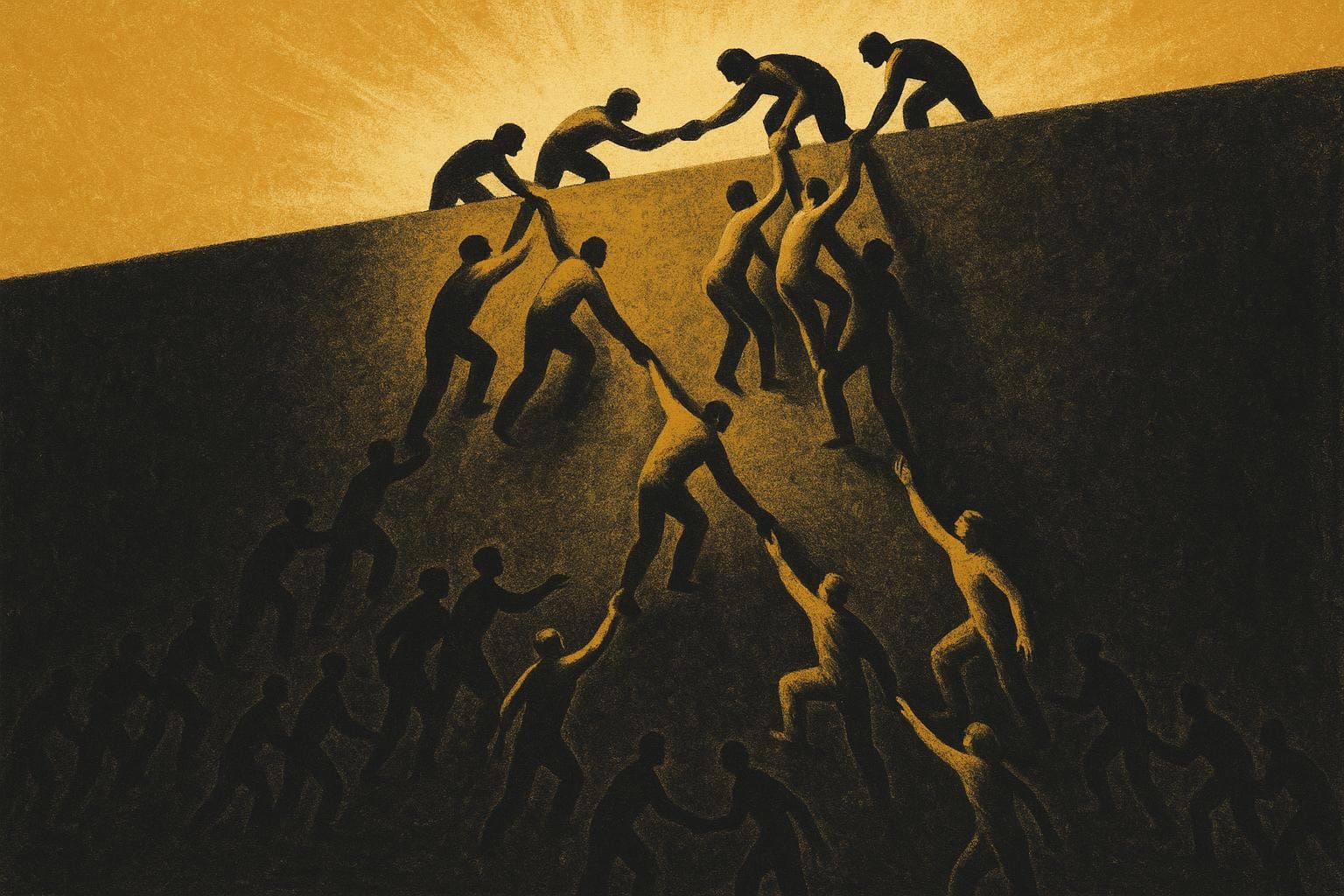
The wall is a question about what kind of world we're building and whether we're building it for everyone or just for the people who own the tools.
I don't have a clean answer. Nobody does. But I know that "let it ride and hope for the best" is a surrender. And the people who will pay for that surrender aren't the ones making the decisions.
What You Can Do
If you've read this far, you're already doing the most important thing: paying attention.
Beyond that:
Ask questions out loud. When your company announces an AI initiative, ask who it displaces. When a tech CEO celebrates efficiency gains, ask where the savings go. These are the questions a healthy society is supposed to ask.
Support the people around you. If someone in your life is facing displacement, the worst thing you can do is tell them they should have seen it coming. The best thing you can do is treat their experience as real and worth responding to.
Demand better from the people in charge. The decisions being made right now (about regulation, about labor protections, about how AI's gains are distributed) will shape the next twenty years. Those decisions shouldn't be made by the companies building the technology alone. They require public pressure, informed citizens, and leaders who understand that GDP growth isn't the same as human flourishing.
Don't let anyone tell you this is simple. It's not. The technology is extraordinary. Some of what it enables will genuinely make lives better. But extraordinary tools in the hands of systems that prioritize profit over people produce extraordinary damage. Holding both of those truths at once is the job.
The wall is here. The question is whether we reach for each other.
The Signal covers the wall from every angle — market evidence, geopolitics, personal survival, moral reckoning. This series is free. But Signal subscribers get more: daily AI intelligence briefs, deep-dives, and the full Intelligence Layer — player profiles, company trackers, and analysis you won't find in a news feed.
Free subscribers get access to everything we've published. It takes 30 seconds.
👉 Subscribe free at thesignal.press →
The Vertical Wall Series: What Is the Wall? · Follow the Money · The Wall Is a Weapon · What Do We Owe Each Other? (you are here) · The Wall Is Here