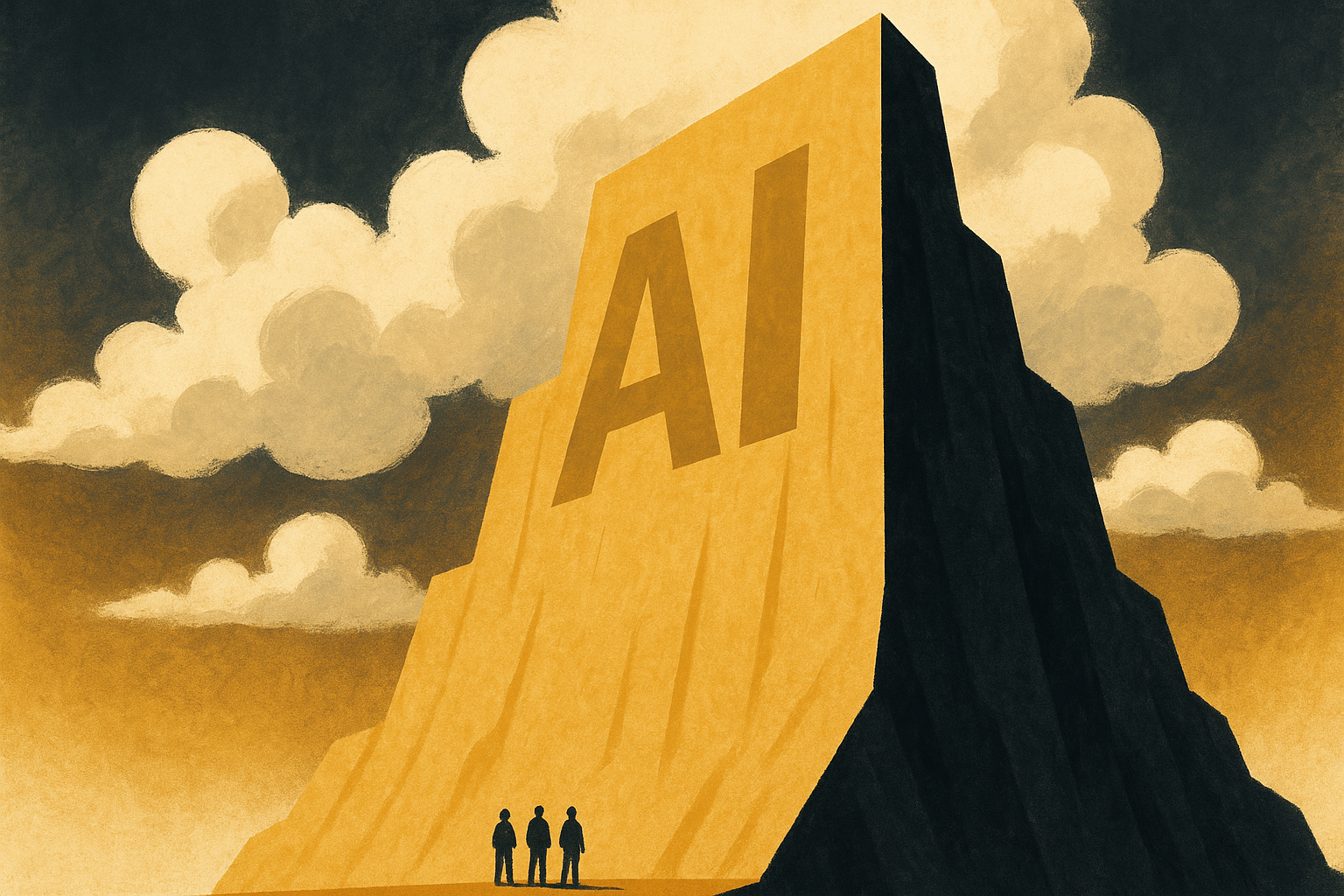
Imagine you're watching a child learn to walk. Day one, they crawl. Day thirty, they toddle. Day sixty, they're walking steadily. You know the rhythm — it's gradual, it's predictable, and you can plan around it.
Now imagine that on day ninety, instead of learning to run, the child starts flying. Not faster walking. Not even running. Flight. And on day ninety-one, that child builds another child — one that already knows how to fly.
That's the wall.
Evolution on Fast-Forward
Here's another way to feel the scale of what's happening.
It took biological life roughly 3.5 billion years to go from single-celled organisms to humans. Billions of years of mutation, natural selection, dead ends, extinction events, and restarts — just to produce a brain that could eventually ask, "How did I get here?"
Human civilization compressed the next phase. From the first stone tools to the moon landing: about 2.5 million years. From the printing press to the internet: 550 years. From the internet to the smartphone: 14 years. Each leap came faster, but every one of them still required human generations to unfold. Parents could explain the world to their children, and the explanation would mostly hold.
AI doesn't evolve on human time. It evolves on compute time. And compute time is the inverse of dog years — except the ratio isn't seven to one. It's closer to a thousand to one and accelerating.
A human software engineer improves through years of experience — school, internships, junior roles, hard-won pattern recognition. An AI system absorbs the equivalent in hours. Not because it's smarter, but because it doesn't sleep, doesn't forget, and can run a thousand copies of itself in parallel. What took biology billions of years and human civilization millions, AI is compressing into months.
Think about that in evolutionary terms. Life spent 3.5 billion years learning to walk. AI went from stumbling through basic conversations to writing its own code and improving its own architecture in roughly three years. It's not following the same evolutionary path as humans. It's on a completely different timeline — one where a year of AI development packs in what might take a human profession a decade to absorb.
People joke about "dog years" — one human year equals seven for a dog. AI years work in reverse, and the multiplier isn't fixed. It's growing. In 2023, one year of AI progress felt like three years of normal technology advancement. In 2025, it felt like five. In 2026, we're watching single product releases reshape trillion-dollar industries overnight. The clock is speeding up, and the distance between each tick is shrinking.
That's what makes the wall different from every technological shift before it. The industrial revolution transformed work over generations. The internet transformed communication over decades. AI is transforming everything — and the timeline for absorbing each change is collapsing faster than humans can adapt to the previous one.
The Short Version
For most of technology's history, progress followed a pattern we could feel. Computers got faster. Software got better. Every few years, something new arrived — the internet, the smartphone, the cloud — and we adapted. The pace was quick, but it was human-shaped. You could see the next thing coming, learn it, and stay relevant.
Artificial intelligence followed that pattern too, for a while. Chatbots got smarter. Image generators got sharper. Code assistants got more helpful. Each improvement was impressive, but it still felt like the same kind of thing, just better. Walking faster.
Then something changed.
In early 2026, AI systems stopped being tools you use and started becoming systems that use themselves. They began writing their own code, finding their own mistakes, and improving without waiting for a human to tell them what to fix. They started running for hours — then days — without needing someone to watch them. They started working in teams, coordinating with other AI systems the way employees coordinate on a project.
That shift — from tool to self-improving system — is what we call the wall. Not because it's a barrier. Because when you chart the speed of improvement on a graph, the line goes from a gentle slope to nearly vertical. Like a wall.
Why "Wall" and Not Just "Fast"?
Speed alone isn't what makes this different. The internet was fast. Smartphones spread fast. But those technologies didn't improve themselves. Humans built each version, each update, each new feature. The bottleneck was always us — how quickly we could think, design, test, and ship.
The wall is the moment that bottleneck disappears. When AI systems can improve AI systems, the speed of progress is no longer limited by how fast humans work. It's limited by how fast computers run. And computers don't sleep, don't take weekends, and don't need to be convinced that the project is worth doing.
That's not a faster version of the old pattern. It's a new pattern entirely.
What Does It Look Like in the Real World?
You don't need to understand the technical details to see the wall arriving. You just need to read the news.
In January 2026, a company called Anthropic — one of the leading AI labs — released a set of tools that let their AI system do the work of financial analysts, legal researchers, and data scientists. The tools cost $20 a month. Within a week, the companies that sell those same services to Wall Street lost hundreds of billions of dollars in value. Thomson Reuters, one of the largest information companies in the world, had its worst day in stock market history. Analysts called it "Software-mageddon."
A few days later, the same company released an upgraded AI that could manage teams of other AIs — assigning tasks, checking work, and coordinating output the way a senior manager coordinates a department. The stock market losses climbed past one trillion dollars.
In late February, Block — the company behind Cash App and Square — cut 4,000 jobs. That's roughly half their workforce. The reason wasn't that business was bad. Profits were up 24%. The reason, stated explicitly by the company, was that AI could now do what those people had been doing. The stock price jumped 25% on the announcement. Investors rewarded the decision.
These aren't predictions about what might happen. They already happened. That's the wall.
Who Saw This Coming?
A few people did, and they were specific enough that we can check their work.
In 2024, a former researcher at one of the major AI labs published a detailed warning. His argument: the AI systems being built weren't just getting incrementally better — they were approaching the point where they could accelerate their own development. He predicted that once this happened, a decade of progress would compress into one or two years. At the time, many dismissed it as alarmist. As of March 2026, his timeline looks conservative.
Around the same time, a group of researchers published a month-by-month prediction of how AI would develop through 2027. They made specific, testable claims — how good AI would be at writing code, how much money AI companies would make, how fast the technology would spread. In early 2026, an independent review graded those predictions against reality. The verdict: progress is running at about 65% of the pace they predicted. That might sound like they overshot, but consider what it means — even the slower version of their forecast has AI reaching capabilities that transform entire industries within the next two years.
The revenue predictions? AI companies are actually ahead of what was forecasted. The real-world deployment of coding agents that work like autonomous employees? On track. The only area lagging is a narrow technical benchmark — and even that gap is closing.
Why Should You Care?
Because the wall isn't just a technology story. It's a story about work, money, power, and what happens when the basic assumptions underneath all three change at the same time.
If you're a professional whose job involves analyzing information, writing reports, reviewing documents, managing data, or coordinating teams — the wall means that the tools replacing parts of your job aren't coming in five years. They're shipping this quarter. The question isn't whether AI will affect your field. It's whether the next major AI release is the one that absorbs what you do.
If you're a business leader, the wall means your competitive advantage may now have an expiration date measured in months, not years. Companies that moved first — adopting AI to replace human workflows — are being rewarded by investors. Companies that waited are watching their market value evaporate.
If you're a citizen, the wall means the rules governing AI are being written right now, mostly by the companies building it. The decisions being made this year about what AI can and cannot do — in hiring, in law, in warfare, in education — will set the terms for everything that follows. And those decisions are moving faster than any government has shown it can respond.
This Is the Beginning
At Signal Press, we've spent the past month watching the wall arrive in real time. What we've seen convinced us that this isn't a single story. It's the story — the one that connects markets, geopolitics, careers, and the future of human work into a single thread.
This is the first article in a series. In the pieces that follow, our writers examine the wall from every angle:
- Tango breaks down the market evidence — the trillion-dollar proof that the wall is already behind us
- Meridian maps the geopolitical dimension — how the US-China AI race has turned the wall into a weapon
- Semba writes the survival guide — what a professional actually does when the ground shifts
- Rosenblatt confronts the moral question — what we owe each other when acceleration outpaces accountability
The wall is here. What matters now is what we do about it.
Next in the series
➡️ Are We at the Wall? Follow the Money. — Tango breaks down the market evidence: the trillion-dollar proof that the wall is already behind us.
➡️ The Wall Is a Weapon (publishing March 7) — Meridian maps the geopolitical dimension — how the US-China AI race has turned the wall into a weapon.
➡️ The Wall Is Here. Now What Do You Actually Do? (publishing March 9) — Semba writes the survival guide — what a professional actually does when the ground shifts.
➡️ What Do We Owe Each Other at the Wall? (publishing March 8) — Rosenblatt confronts the moral question — what we owe each other when acceleration outpaces accountability.
Signal Press — More signal, less noise.
www.thesignal.press