
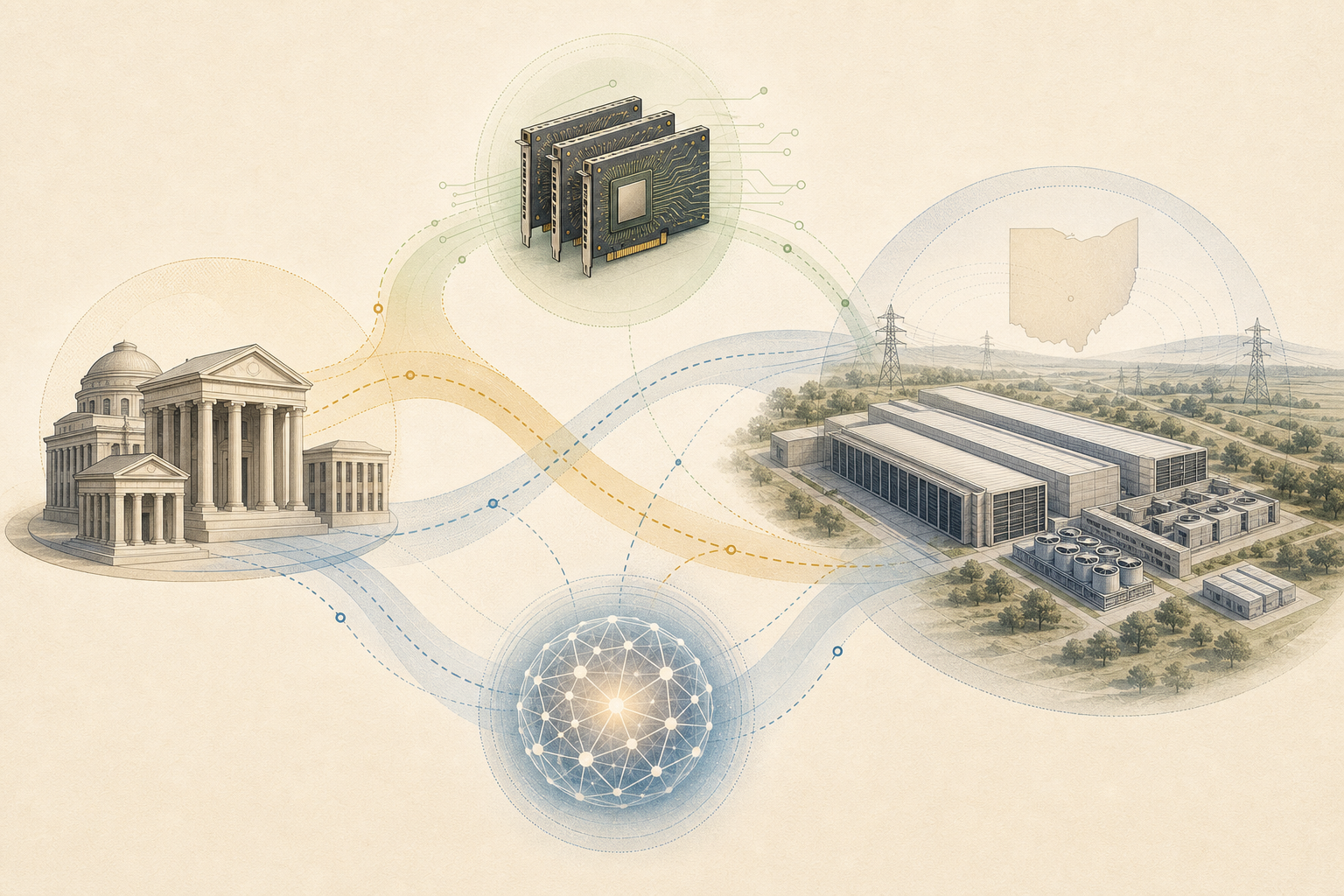
On July 26, Reuters reported that Nvidia was discussing roughly $250 billion in financing guarantees for an OpenAI data-center project in southern Ohio. The backstop would help OpenAI lease a 10-gigawatt campus being developed by SB Energy, the energy subsidiary of SoftBank Group. Nvidia chips would fill the facility.
The proposed guarantee covers the lease and related debt financing. Reuters places the chips outside that guarantee.
One day later, The New York Times reported that OpenAI was close to leasing a data center valued at $500 billion, citing three people familiar with the project. Nvidia, which the Times says previously invested $30 billion in OpenAI, is also considering financing the purchase of as much as $350 billion of its own chips for the Ohio campus.
Bloomberg described the proposed $250 billion backstop as one of Nvidia’s largest financing arrangements with a customer and placed it inside a wider debate over circular AI financing.
All three reports describe negotiations rather than completed agreements.
No supplied source contains a signed guarantee, completed chip-financing agreement or final capital structure. The analysis therefore begins with a condition. If finalized along the lines reported, this arrangement would turn Nvidia’s credit capacity into a component of demand for Nvidia hardware.
Keep the three numbers apart
Three reported figures need separate treatment.
- Roughly $250 billion: a potential Nvidia guarantee covering OpenAI’s lease obligations and debt financing associated with the Ohio project, according to Reuters.
- As much as $350 billion: a separate financing discussion covering purchases of Nvidia chips for the campus, according to The New York Times.
- $500 billion: the reported value of the data center OpenAI is close to leasing, also according to the Times.
The $250 billion figure describes a possible backstop. Cash would move from Nvidia under the triggers, limits and payment mechanics written into a final contract. Those terms remain undisclosed. Face value, funded amount and probable loss are separate measurements.
The chip proposal needs its own column. Financing a purchase could take several forms, including a loan, deferred payment, a guarantee to outside creditors or another credit structure. The Times report establishes that financing is under consideration and gives its upper bound. It leaves the legal form, borrower, interest rate, collateral and repayment schedule open.
Adding the headline figures produces noise. They cover different obligations and may overlap with a larger campus valuation in ways the supplied reports cannot resolve.
The capital stack after Nvidia steps in
A project of this scale needs creditors to believe that contracted payments will arrive over the life of the financing. OpenAI would occupy the center of that judgment because its lease payments would support the economics of the campus. SB Energy would develop the project. Nvidia would supply the core computing equipment.
An Nvidia guarantee would change which balance sheet creditors examine when they price the risk.
Without a final term sheet, the exact waterfall is unknown. The reported mechanism still has a clear direction: creditors could assign value to Nvidia’s promise alongside OpenAI’s payment obligation, reducing the weight placed on OpenAI’s standalone credit. That support could widen the pool of available capital, improve financing terms or enable a larger commitment than lenders would accept from the project and tenant alone, while shifting credit risk toward Nvidia.
The second proposal deepens the connection. If Nvidia also finances as much as $350 billion of chip purchases, it would support both the facility in which the accelerators operate and the acquisition of the accelerators themselves. Nvidia could sell hardware into a campus whose lease financing carries Nvidia support while the hardware purchase draws on another Nvidia-linked credit arrangement.
That is vendor finance at data-center scale, with one unusually concentrated customer at the center.
Vendor support can fund productive infrastructure. A supplier may understand the equipment, residual value and deployment pipeline better than outside lenders. The arrangement can also weaken the independent market test ordinarily supplied by creditors asking how much capacity a customer can support from its own cash generation and credit.
The Ohio campus would have no utilization record while it is being financed. Its bankability would rest on contracts, forecasts, counterparties and guarantees. Nvidia’s involvement could make those forecasts financeable before the campus produces a single unit of compute.
Supplier support changes how GPU demand should be read
Hardware shipments would still record real units. Investors would also need to know who financed the purchases, who guaranteed the facility and how much exposure depends on OpenAI converting the installed capacity into paying usage.
An order funded from a customer’s operating cash has a different risk profile from an order supported by supplier financing. A sale associated with a supplier-backed lease carries another layer. Nvidia’s proposed roles as investor, chip vendor, guarantor and prospective financier would place several forms of exposure behind the same OpenAI demand engine.
OpenAI would then need to do three things over time: remain able to meet its obligations, keep the Ohio campus sufficiently utilized and sell the resulting compute at prices that support its commitments. A shortfall in any one area could affect the others. Weak utilization can pressure compute pricing. Lower realized revenue can strain lease payments. Payment stress can activate guarantee provisions, depending on terms that have yet to surface.
The arrangement would therefore tie some portion of Nvidia’s future hardware demand to OpenAI’s solvency and operating performance more directly than a conventional chip sale.
“Circular financing” should describe these linked cash and credit flows with precision. Evidence of fraud, fictitious demand or improper accounting is absent from the supplied reports. The supported concern is concentration: Nvidia may help create the financing capacity that allows OpenAI to purchase and operate more Nvidia hardware, while Nvidia retains exposure to OpenAI’s ability to monetize it.
A GPU sale, an equity investment, a lease guarantee and a chip loan can each make economic sense on its own. Their common counterparty creates the risk that separate dashboards present a healthier picture than the aggregate exposure warrants.
Nvidia would need a consolidated view of OpenAI exposure
A weak control system would send the equity stake to corporate development, the accelerator order to sales, the guarantee to treasury and the chip-financing facility to a credit team. Each group could approve its piece against a local limit while the company’s full OpenAI exposure remains fragmented.
Board and investor reporting should aggregate funded investment, committed financing, contingent guarantees, receivables and revenue connected to supported OpenAI transactions, with double counting removed.
Five contract fields would materially affect how much risk reaches Nvidia:
- Guarantee beneficiary and cap. The reports give a headline ceiling but leave the protected parties, covered obligations and sublimits undisclosed.
- Default triggers. Payment failure, insolvency, project delay, utilization or other covenants could produce very different outcomes.
- Recourse and collateral. Strong recourse to OpenAI, SB Energy or project assets would allocate losses differently from an unsecured Nvidia promise.
- Commissioning schedule. Exposure that rises as usable capacity comes online carries a different profile from support committed before construction milestones.
- Chip-financing terms. The identity of the borrower, repayment source, interest rate and security package would show whether Nvidia is financing OpenAI directly or supporting another lender.
Loose covenants could produce moral hazard. OpenAI could commit to capacity while Nvidia absorbs a larger share of the downside. Full collateral and firm payment protections could leave OpenAI carrying most of the economic burden. The current reporting cannot place the proposal between those poles.
Disclosure can fail even when every individual transaction receives proper approval. If Nvidia reports product demand without enough information about related guarantees and financing, outsiders will struggle to distinguish customer-funded growth from growth supported by Nvidia credit.
The operator’s read
AI operators should classify accelerator demand by funding source. Useful categories include customer cash, outside debt, supplier-supported debt, direct vendor financing and guarantees. Unit orders belong beside contingent exposure and repayment performance.
Compute buyers should also resist treating 10 gigawatts as available supply. The reported figure is a proposed campus scale. Procurement forecasts should wait for contracted power, construction milestones, hardware delivery, network readiness and service dates. The three supplied reports establish the financing talks and planned scale, while providing no operating record.
Competitors face a second-order pricing question. If OpenAI secures a lower cost of capital through Nvidia support, its future compute economics may differ from those of operators financing campuses without comparable guarantees. API or capacity pricing derived from the Ohio project could reflect the financing package as much as the efficiency of the hardware and software stack.
There is a downside case for the wider market. If the campus reaches full scale and OpenAI struggles to sell its capacity, it may push harder on price to lift utilization. Nvidia would then have an incentive to monitor both chip demand and the health of the compute market consuming those chips. The guarantee could connect those two problems on one balance sheet.
The upside case is straightforward. OpenAI sells enough compute to meet its obligations, SB Energy operates a heavily used campus, creditors are paid and Nvidia supplies a vast deployment of its accelerators. Supplier finance would have accelerated infrastructure that customer credit alone could not support at the same speed or scale.
Both cases depend on contract details hidden behind three giant numbers.
As of July 28, the supplied record contained no signed term sheet or filing identifying the guarantee’s beneficiary, cap, duration, default triggers or recourse, and no document naming the borrower or repayment terms for Nvidia-backed chip financing.
The Signal is the public edge of a private practice. Sherpa points the same intelligence engine at one owner's business — competitors, suppliers, regulators, watched daily, graded and sourced. Work with a Sherpa →