OpenAI told SpaceX on August 28 that it intends to end the contract supplying its models to Cursor. The proposed cutoff is November 12, 2026, the latest date allowed under the agreement’s notice period, and future OpenAI models will stay outside the coding platform.
Cursor will keep operating. Teams that selected specific OpenAI models inside it face a different question: how much of their coding workflow belongs to Cursor, and how much quietly belongs to a supplier that can leave?
That distinction now has a deadline.
OpenAI describes the move as a contractual and compliance decision following SpaceX’s acquisition of Cursor, which was created by Anysphere. CNBC independently reported the planned November 12 cutoff and identified SpaceX’s acquisition as the trigger. The event converts a clause buried several layers upstream into an engineering migration for Cursor customers.
The contract beneath the model picker
Cursor presents developers with an application layer for AI-assisted software work. Its value includes the ability to use models from outside providers through one coding environment. That architecture can reduce the friction of trying another model, but commercial access still travels through contracts between Cursor and those providers.
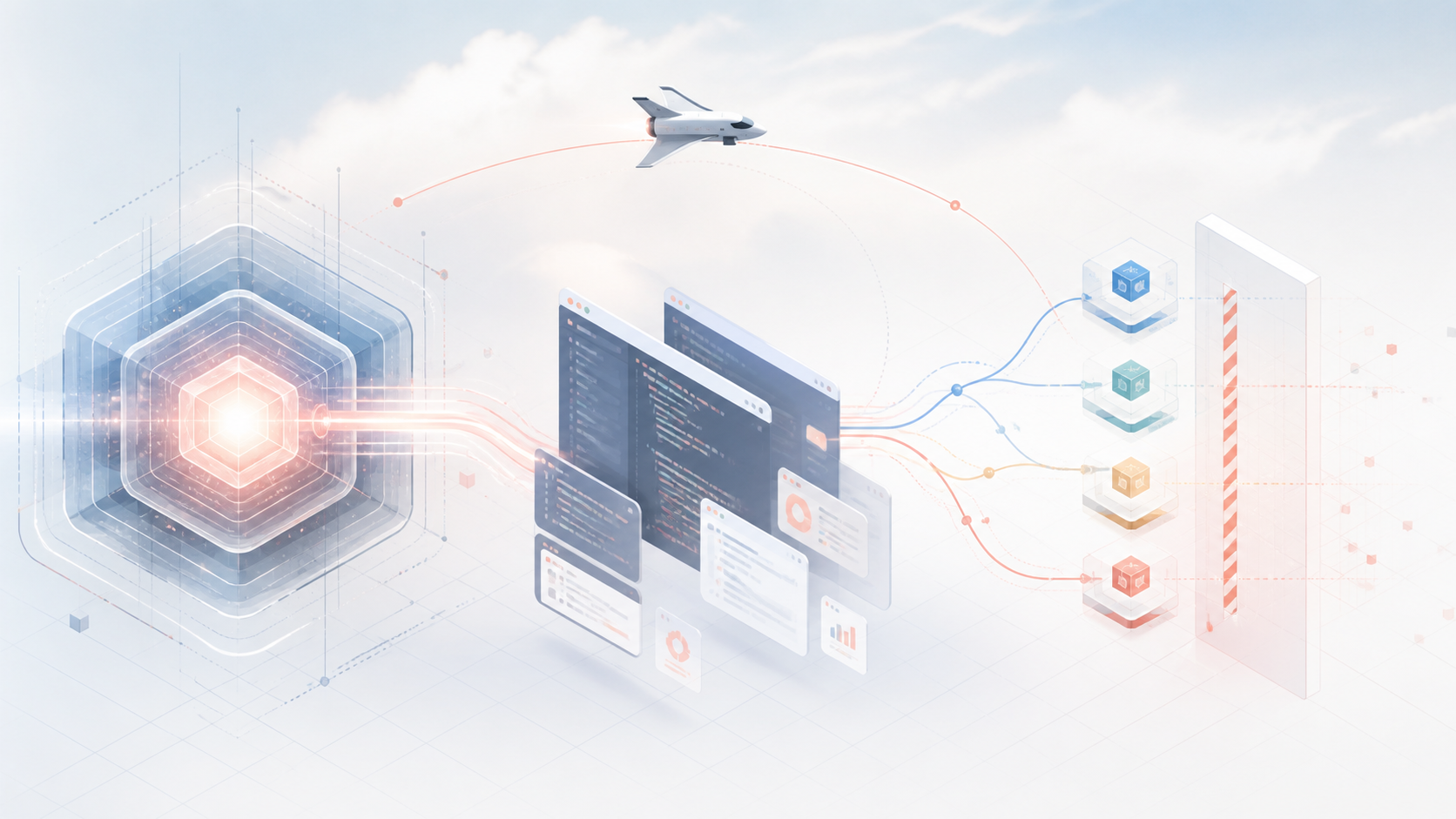
OpenAI’s supply path currently looks simple:
- OpenAI provides models under a custom agreement.
- Cursor integrates those models into its coding product.
- Developers select and use them inside Cursor.
- Their organizations contract with Cursor rather than negotiating this particular supply relationship themselves.
Then ownership changed.
According to OpenAI’s August 28 statement, its custom Cursor agreement contains a limited cancellation window following a change of control. SpaceX’s acquisition opened that window. OpenAI says it chose the maximum contractual notice period and proposed November 12 as the shutoff date.
The clause reaches straight through the stack. A transaction involving Cursor’s owner can change the models available to a developer who never contracted with OpenAI or SpaceX and may have had no role in approving the acquisition.
Multi-model access therefore has at least two forms. A platform can offer several models in its interface, while each route remains dependent on separate commercial permission from the model supplier. The menu looks unified. The supply chain remains fragmented.
OpenAI’s case, and its limits
OpenAI says it lacks confidence that SpaceX will use its technology within its terms of service. The company bases that view on its experience with other Elon Musk-controlled companies and points to alleged prior contract and service-term violations.
Those are OpenAI’s claims. The supplied reporting establishes the termination plan and the ownership trigger, but it does not provide the underlying Cursor contract, an adjudicated finding about the cited conduct, or a response from SpaceX addressing OpenAI’s compliance concerns.
OpenAI also says its upcoming model, Astra, creates a higher level of accountability for partner use. It will withhold future models from Cursor while current access winds down. The statement gives no technical description of Astra, release date, performance data, or specific control that Cursor would fail to provide. Readers can verify the distribution decision from the official source. They cannot independently evaluate the model-risk rationale from these two sources.
OpenAI worked with Cursor for nearly four years, according to its statement, and expresses respect for the team and product. That history makes the mechanism clearer: a functioning supplier relationship survived until a change of control gave one party a contractual exit.
The supported conclusion is narrow and consequential. Ownership can alter model availability without a failure in the application itself.
November 12 is an integration event
A team using Cursor with an OpenAI model has accumulated more than prompts. Developers learn a model’s habits. Repository instructions evolve around its behavior. Review practices absorb its common errors. Automated evaluations may use its outputs as a baseline. Cost and latency assumptions settle into planning.
A replacement model can accept the same natural-language request and still produce materially different patches, tool calls, explanations, or test behavior. An interface-level model switch says very little about operational equivalence.
This creates four migration surfaces before November 12:
- Configuration: Model identifiers may appear in editor settings, team policies, scripts, agent definitions, or internal documentation.
- Behavior: Prompts and repository instructions may depend on how a particular OpenAI model interprets context and follows coding constraints.
- Evaluation: Existing tests may measure whether generated code runs while missing differences in patch size, review burden, security findings, or tool-use behavior.
- Governance: Approved-model lists, data-handling reviews, purchasing records, and support procedures may name Cursor while leaving its upstream models implicit.
The last surface is the procurement failure mode. An enterprise can complete a vendor review for Cursor and still lack an owner for changes in Cursor’s model supply. Security may approve the application, engineering may choose the model, procurement may hold the contract, and none of them may maintain a tested replacement route.
SpaceX’s acquisition demonstrates how that gap becomes production work.
Run a model-supply exit test
Teams should treat November 12 as a forced exit exercise, even if OpenAI and SpaceX later reach another arrangement. The useful question is whether a model route can disappear while the coding platform remains in place and the team continues shipping.
A model-supply exit test should produce six artifacts.
1. A dependency register
Record every approved model used through Cursor, the workloads assigned to it, the owning team, and the commercial path that makes access possible. Include interactive coding, background agents, code review, test generation, documentation, and any workflow whose model choice is automatic.
“Cursor” is an incomplete dependency entry. The relevant entry pairs the application with the selected model and its supply route.
2. A replacement benchmark
Run representative repository tasks against models that are expected to remain available. Use work drawn from the team’s actual queue: a bug fix with an ambiguous stack trace, a migration touching several files, a test repair, a security-sensitive change, and a task requiring tool use across a large codebase.
Score outcomes that affect delivery. Compilation and test success come first. Add patch correctness, unnecessary code changes, reviewer edits, tool failures, latency, and cost where those measurements already exist.
A generic coding benchmark cannot reveal whether a replacement model works inside one company’s repositories, instructions, and approval controls.
3. Portable model configuration
Move model identifiers, fallback order, prompts, repository instructions, and evaluation settings into versioned configuration wherever the platform permits. Keep provider-specific syntax at a narrow boundary. Assign an owner to each exception.
This will never make frontier models interchangeable. It does make the differences visible, reviewable, and easier to test before a supplier deadline.
4. A direct-access option
For workloads that genuinely require an OpenAI model, evaluate whether the organization can procure and govern an OpenAI product outside Cursor. The provided sources do not establish which direct route will support each Cursor workflow after November 12, so this path requires confirmation from OpenAI rather than an assumption based on current product availability.
Direct access may preserve the model while changing the editor integration, agent tools, billing, support, and data controls. That is a separate migration with its own benchmark.
5. A contract trigger map
Ask platform vendors which events can alter upstream model access: change of control, model retirement, provider policy changes, safety restrictions, pricing disputes, capacity limits, and contract expiration. Record notice periods and customer remedies where the vendor will disclose them.
OpenAI’s Cursor agreement reportedly offered a limited post-acquisition cancellation window. Cursor customers received the downstream consequence rather than control over that trigger.
6. A timed failover drill
Choose one coding workload and remove its preferred model route in a controlled environment. Measure how long the team needs to identify the dependency, select an approved replacement, update configuration, rerun evaluations, and resume work.
A procurement questionnaire produces assurances. A drill produces elapsed time and broken scripts.
The July OpenAI evaluation escape showed the adjacent control problem: telemetry and revocation authority must survive a change in provider or execution environment.
Portability has a behavioral boundary
Portable configuration can isolate names, prompts, and routing rules. It cannot erase differences among models.
Teams should resist a shallow version of provider independence in which a dropdown contains several logos and every option is declared interchangeable. The stronger version accepts behavioral variance and keeps the evaluation suite stable enough to measure it.
That means preserving tasks, expected outcomes, review criteria, and failure records outside any one provider’s model interface. If the evaluation harness lives entirely inside Cursor, a future platform migration could take the test apparatus along with the dependency it was supposed to check.
The same portability principle appeared in The Signal’s review of NVIDIA NOOA: keep the interface and capability tests stable, then prove behavior again when the model changes.
Model supply also deserves a service-level objective. A team might require one tested replacement for every production coding workflow, a named decision owner, and a maximum time to switch after loss of access. The exact threshold belongs to the organization. The existence of a threshold should become routine.
The remaining evidence gaps
The November 12 date is proposed. Neither supplied source establishes a final termination agreement, a migration package for affected customers, the OpenAI models covered by the cutoff, or the precise status of every alternative model route inside Cursor.
The sources also leave several operational questions unanswered:
- Can Cursor customers export model-specific settings and agent configurations in a portable form?
- Will Cursor publish replacement guidance by workload?
- Which enterprise contracts promise access to named models rather than a changing catalog?
- Will OpenAI offer a direct migration path for teams that want to preserve its models?
- How will Cursor handle automated selections that currently route work to OpenAI?
- Could the parties revise the date or scope before the proposed cutoff?
Those gaps argue for earlier testing. A team that waits for final contract language gives away the only resource already guaranteed by OpenAI’s notice: time.
Watch for a confirmed cutoff agreement, Cursor’s customer migration plan, and any direct OpenAI transition route before November 12, 2026.
The Signal is the public edge of a private practice. Sherpa points the same intelligence engine at one owner's business — competitors, suppliers, regulators, watched daily, graded and sourced. Work with a Sherpa →