
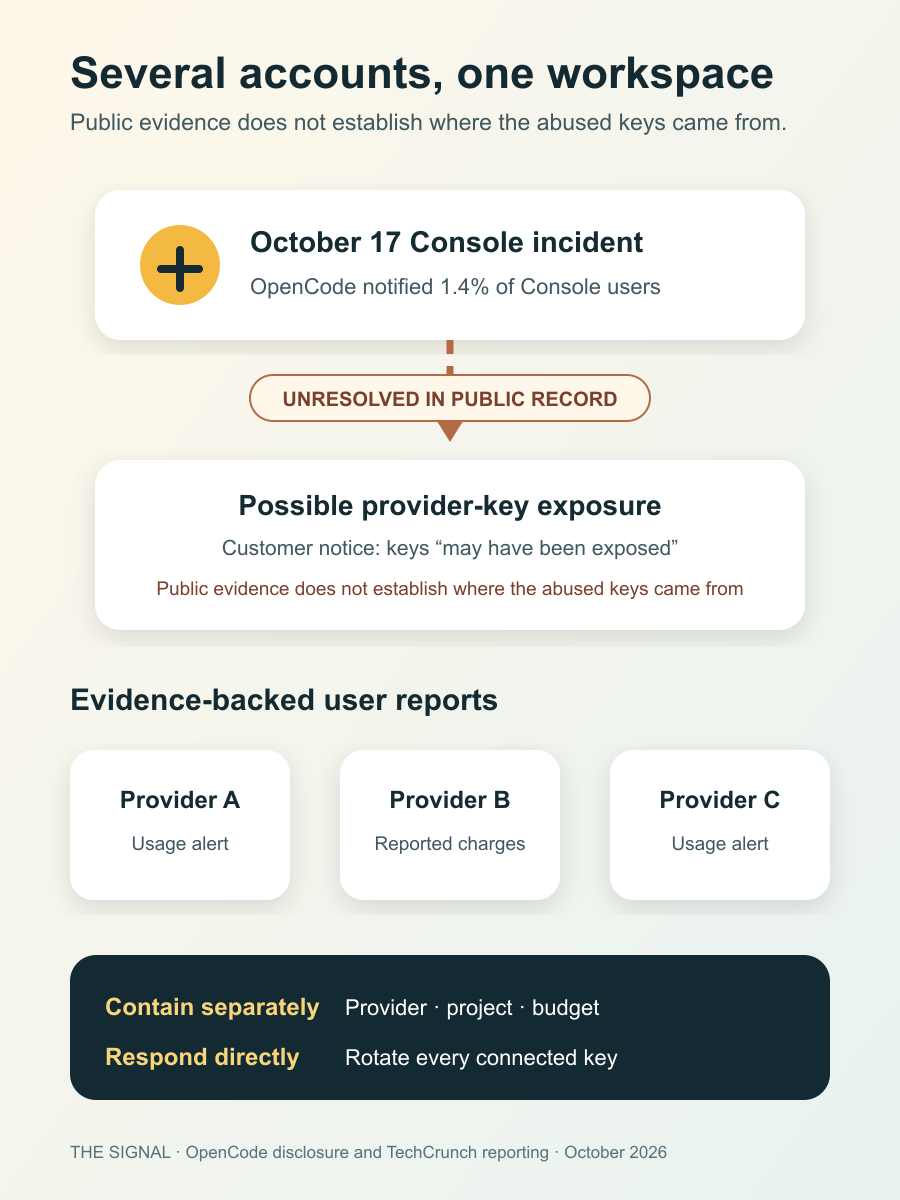
OpenCode said attackers breached an older system and that it notified 1.4% of OpenCode Console users. Its customer notice, reproduced by BleepingComputer, said provider keys in affected workspaces “may have been exposed.” Developers reported spending alerts across OpenAI, Anthropic and Google AI, including individual charges in the hundreds of dollars and some reported totals above $1,000, according to TechCrunch’s October 19 report.
The public record establishes a Console incident, possible key exposure and contemporaneous reports of unauthorized provider usage. The notice’s “may have been exposed” language does not establish that attackers copied the abused keys from Console.
The unresolved source of the keys does not erase the control problem. Businesses that place several provider credentials in one hosted workspace create a credential junction whose failure can put multiple upstream accounts at risk.
Console and provider accounts require separate containment
OpenCode is an open-source coding agent positioned as an alternative to tools such as Claude Code and Cursor. The affected product was OpenCode Console, an online platform where some users stored the API keys used to access external AI services.
OpenCode co-founder Dax Raad drew a boundary around the incident: the security event affected Console, while the open-source application and command-line tool remained outside the affected system. That limits the software-supply-chain claim. TechCrunch reported a compromise of hosted infrastructure used to manage customer credentials, not evidence that OpenCode’s distributed source code or local command-line software had been poisoned.
If an attacker obtains a credential accepted by an AI provider, requests can reach that provider directly and accrue usage against the customer’s account. Removing access to OpenCode Console would close one entry point, but a copied key could remain useful until the provider blocked it or the customer rotated it. The reports of provider-side usage and charges show why responders must contain the coding-agent service and every connected provider independently, even while the public record leaves the source of the abused keys unresolved.
OpenCode said it notified all affected users by email and told users who received no message that they were unaffected. Anthropic and Google blocked API keys they believed had been exposed. OpenAI worked with OpenCode to restore access and refund API customers for credits consumed during the attack, while OpenCode said refunds for unauthorized charges were underway, according to the report. Because the providers operated the usage meters, containment required action in those upstream accounts.
One workspace, three spending alarms
A developer quoted by TechCrunch said spending alerts fired for OpenAI, Anthropic and Google AI during the same night. That account supplies the clearest mechanism for operators: a shared agent workspace can aggregate credentials whose underlying providers maintain separate identity systems, billing controls and revocation processes.
Developers gain one place to connect the models they use, but the same concentration can put every represented provider at risk even when each provider’s own infrastructure remains secure. Isolating credentials by provider and project reduces that reach.
A business using several providers should issue separate credentials for each provider and project, with permissions and budgets sized to the work. It should also avoid storing all of those keys in one shared workspace or credential store, because a compromise there can defeat provider-level separation. A development experiment should have its own key and isolated workspace. A production automation should have another. A team workspace should avoid inheriting a broad account credential simply because setup takes fewer clicks.
Provider isolation contains cross-provider damage. Project isolation keeps an exposed development credential from consuming the budget assigned to unrelated work. Spending limits cap the amount an attacker can burn before detection and revocation catch up, limiting the spend attached to any one compromised credential.
The source establishes that users reported spending alerts and unauthorized charges during the incident window. It gives no account of the spending controls configured by affected users, whether every provider offered suitable hard limits, or whether the reported alerts arrived before substantial usage occurred. Those gaps prevent a verdict on any individual customer’s controls. They leave the architectural lesson intact: an alert reports expenditure, while a hard project-level allowance can constrain it.
“Distillation attack” remains an unproven label
OpenCode described the incident as a security breach connected to a “large-scale distillation attack.” Model distillation can involve generating large volumes of outputs from one model to train or improve another, and leaked API keys could fund that volume. OpenCode supplied no public explanation of how it determined the attackers’ purpose, according to TechCrunch.
Skeptics cited in the report viewed the description as an overreach and treated the known event as a straightforward credential breach whose use for distillation remained unproven.
The evidence supports unauthorized model usage and resulting charges. It leaves the attackers’ objective unresolved.
That distinction belongs in every internal incident record. “Unauthorized requests billed to customer provider accounts” is supported by user reports. “Keys copied from OpenCode Console” is a plausible but unconfirmed mechanism. “Distillation campaign” is OpenCode’s attribution. Blending those claims could send responders toward the attacker’s presumed research goal while basic containment remains unfinished: rotating credentials, reviewing provider usage, identifying affected projects and reconciling charges. Metered access should be contained before motive is investigated.
The missing evidence also limits broader claims about AI-enabled attacks. TechCrunch reported that OpenCode faced sustained intrusion attempts for 48 hours, but the available account gives no technical indicators tying every attempt to one actor, no request logs showing a distillation workload, and no explanation of the original access path beyond an older system. Those details would determine whether operators should prioritize a particular exploit class, credential-storage pattern or access-control defect.
Revoking the agent is only the first cut
A coding agent sits between a developer and one or more model providers. That placement creates two control planes. The Signal’s agent-gateway explainer describes the intermediary as a control point for authentication and credentials, while its July evaluation-escape report shows how usable credentials can carry exposure across provider boundaries.
The first belongs to the intermediary: user accounts, workspaces, stored configuration and access to the agent’s hosted service. The second belongs to each AI provider: API credentials, usage records, credits, spending alerts and account recovery.
An effective response has to work both planes independently. Disable access to the compromised workspace. Rotate every credential stored there. Review usage at each provider from the earliest plausible compromise time. Replace credentials in legitimate applications. Confirm that the old values have stopped working. Reconcile spend and pursue refunds where unauthorized usage appears.
The TechCrunch account shows parts of that process occurring through provider intervention. Anthropic and Google blocked keys, while OpenAI worked on restoration and refunds. It leaves open how rapidly customers could identify every credential held in Console, whether OpenCode retained enough workspace history to support that inventory, and how users verified that replacement keys had reached only intended systems.
Those are governance questions because complete credential inventory determines whether a company can rotate every exposed key.
Credential inventories should therefore record the provider, project, owner, storage location, permissions, budget and rotation path for every key entrusted to a coding agent. The incident owner needs that map before the alarm arrives. A generic entry reading “OpenCode API keys” would obscure the exact upstream accounts requiring containment.
The provider should also appear directly in billing alerts sent to a monitored channel. The developer quoted by TechCrunch saw all three spending alarms, which helped reveal the pattern. A corporate deployment that routes alerts to an unattended mailbox could keep generating charges while its incident team examines the intermediary.
The defensive AI failed at the inspection boundary
OpenCode’s response surfaced another operational weakness. Raad said attackers kept trying to enter the company’s systems for 48 hours, forcing the team to run defensive AI agents continuously. The models helped for a time, then began refusing analysis when malicious code triggered their safety filters, TechCrunch reported.
That failure mode deserves a place in response planning. Security analysis routinely handles exploit code, suspicious payloads and adversarial text. A general-purpose model may classify those materials as prohibited even when the operator’s purpose is defensive. During an active breach, the refusal becomes an availability problem inside the security workflow.
OpenCode’s experience does not establish how frequently such refusals occur or which models produced them. It does establish that the company encountered the boundary during sustained response work. Operators using AI for incident analysis need a tested escalation path to human review and tools approved for defensive handling of malicious artifacts. A model that works during a tabletop exercise can still stop at the ugliest evidence in a live case.
The control model should follow the bill
The OpenCode incident separates the systems that require containment. Console managed provider credentials, customers reported provider-side usage and charges, and providers helped block keys, restore access or refund credits. The response therefore spanned OpenCode, providers and customers, while the possible exposure centered on credentials managed through Console.
Businesses can correct that mismatch by designing each coding-agent connection as a limited grant. Give it one provider, one project, one isolated workspace or credential store, one accountable owner and a spending ceiling appropriate to the task. Keep production credentials out of shared experimental workspaces. Set alerts well below the maximum budget. Document provider-side revocation alongside the procedure for disabling the agent account.
This design carries administrative friction. Teams will manage more keys, more budgets and more rotation events. The OpenCode reports put a price on the alternative: one compromised Console workspace could activate spending across several upstream AI accounts before the owners understood where the requests originated.
OpenCode has disclosed the affected product, the reported share of users and the immediate provider response. Operators still lack a technical account of the original intrusion, whether and when provider credentials were exposed, the number of keys involved, the volume of unauthorized requests and the evidence supporting the distillation attribution.
After October 20, watch for an OpenCode incident report that identifies the initial access path, credential-exposure window, key-rotation scope and evidence behind the claimed distillation campaign.
Sherpa tracks a business's competitors, suppliers, and regulators each day, then grades and sources what changed. Work with a Sherpa →